As an Amazon Associate we earn from qualifying purchases.
Making an energy drink at home comes down to three ingredients: a caffeine source, something to replace the sugar load, and enough acidity to make it drinkable cold. The point is not to copy a commercial can — it is to control the dose, which a can does not let you do.
Start from the dose, not the recipe
A 500 ml commercial can carries about 150 mg of caffeine. Brewed coffee runs near 95 mg per 240 ml cup, and strong black tea near 47 mg. So two cups of coffee, chilled, already match a full can. Decide your target first — 80 mg for a light drink, 160 mg to match a standard 500 ml can — then work backwards.
Working backwards from the dose also tells you when to stop. If your target is 160 mg and filter coffee delivers 95 mg per 240 ml cup, you need roughly 400 ml of coffee — most of a 500 ml drink, leaving little room for anything else. That constraint is why the recipes below use concentrate or strong-brewed tea rather than ordinary filter coffee.
A base that works
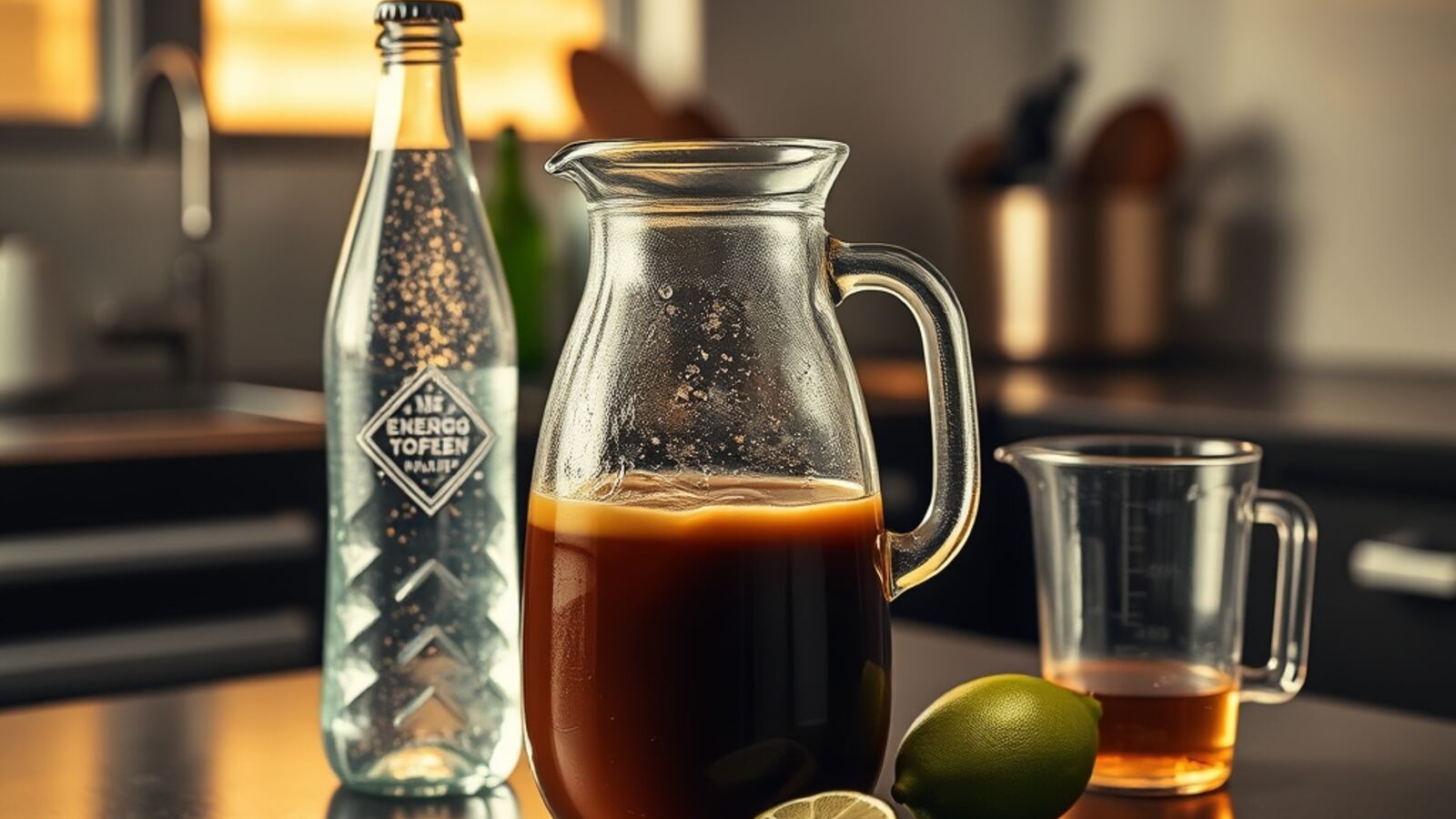
For roughly 500 ml: 240 ml of strong coffee or tea brewed and cooled, 250 ml of sparkling water, the juice of half a lemon or lime, and a pinch of salt. The salt is not optional — it flattens the bitterness that makes cold coffee unpleasant, and it replaces some of what sweat takes out if you are drinking this around exercise.
Proportions matter more than ingredients here. Too little water and the coffee dominates; too much and the drink tastes of nothing. The 240/250 split is a starting point, not a rule — adjust the sparkling water first, because it changes the taste without touching the dose you calculated.
Sweeten to taste after mixing, not before. Two teaspoons of honey add about 12 g of sugar and 45 kcal; the same drink with a sweetener stays near zero. For comparison, Monster Juiced Mango Loco holds 46 g of sugar and 195 kcal in the same volume.
Green tea version, for a lower dose
Steep 4 g of green tea in 300 ml of water at 80 °C for three minutes, cool it, then top up with 200 ml of sparkling water and a squeeze of lime. That lands near 60-70 mg of caffeine — under half a commercial can — and keeps the L-theanine that green tea carries, which is the part people describe as a steadier lift.
Temperature is the variable people get wrong. Green tea brewed at boiling point turns bitter and astringent within a minute, which is why 80 °C and three minutes appear in the method above. Cooling it fast — a jug in an ice bath rather than the fridge — keeps the aroma that slow cooling drives off.
What you cannot reproduce at home, and why it matters
Taurine and the B-vitamin blend in a commercial can are dosed in milligrams that kitchen measurement cannot hit: 2000 mg of taurine is a quarter-teaspoon of a powder most people do not have. Skip them. The evidence that they add anything on top of the caffeine is thin, and the caffeine is the part you can measure and control.
Carbonation is the other gap. A soda siphon gets close; shaking will not. If the texture matters to you, build the drink on sparkling water rather than trying to carbonate the finished mix.
Caffeine content of what you already have
These are the figures to build from. They vary with brewing time and grind, so treat them as ranges rather than constants.
| Source | Serving | Caffeine |
|---|---|---|
| Filter coffee | 240 ml | ~95 mg |
| Espresso | 30 ml | ~63 mg |
| Black tea, strong | 240 ml | ~47 mg |
| Green tea | 240 ml | ~28 mg |
| Matcha, 2 g | 240 ml | ~60 mg |
| Cocoa powder, 10 g | — | ~23 mg |
Three mistakes that make homemade versions unpleasant
Sweetening before tasting. Cold drinks read less sweet than warm ones, so a mix balanced hot ends up cloying cold. Mix, chill, then sweeten.
Skipping the acid. Without citrus the drink tastes flat and the coffee bitterness dominates. Half a lime per 500 ml is the difference between drinkable and abandoned in the fridge.
Brewing hot and adding ice. That dilutes to roughly two thirds strength, so the dose you calculated is not the dose you drink. Brew, cool in the fridge, then build — or brew a third stronger if you are going to ice it.
Cost, compared honestly
A homemade 500 ml drink built on coffee costs a fraction of a can, and the gap widens if you drink one daily. What it costs instead is five minutes and planning: the coffee has to be brewed and cooled in advance. That, not the recipe, is why most people go back to cans — so if you are making this a habit, brew a jug for three days at once.
Three variants, by what you actually want
For a long working session, build on cold brew: 200 ml of cold brew concentrate carries roughly 200 mg of caffeine, so dilute it by half and you land near 100 mg in 500 ml — steadier than a single large dose, and the bitterness is lower than hot-brewed coffee chilled.
For training, keep some sugar: 30-40 g in 500 ml is what a sports drink provides, and it is the one context where the sugar in a commercial can is doing useful work rather than adding calories. Two tablespoons of honey plus the juice of a whole orange gets you there.
For the afternoon, go under 60 mg: green tea base, no added coffee. Caffeine’s half-life is around four hours in adults (2 to 8 hours depending on the person, according to EFSA), so 60 mg at 3 p.m. leaves about 25 mg circulating at 8 p.m. — usually below the threshold that affects sleep onset.
What a can gives you that a jug does not
Two things, honestly. Consistency: the industrial dose is identical can to can, while a home brew varies with steeping time and grind by up to a third. And carbonation with a stable pH, which is a formulation problem rather than a recipe one — a homemade acidic fizzy drink goes flat and separates within the hour.
What the can does not give you is control. You cannot buy a 90 mg version of a 160 mg drink; you can only buy the smaller format, and that costs more per litre. A jug lets you set the number.
Storage, and the mistake that wastes a batch
Brewed coffee or tea keeps 48 hours refrigerated before the taste turns papery — oxidation, not spoilage. Mix the base and keep it plain: add the citrus and the sparkling water per glass, not to the jug. Citrus juice loses its aroma within hours once diluted, and carbonation added to a container that gets opened repeatedly is gone by the second day.
Keeping it safe
European guidance treats 400 mg of caffeine a day as the adult ceiling, and 200 mg as a single serving. Homemade drinks make it easy to pass both without noticing, because you are pouring rather than reading a label. Write down what went in the jug. Pregnancy guidance is lower — 200 mg for the whole day — and children are not in scope for any of this.
Caffeine powder deserves a separate warning: it is sold in bulk and a level teaspoon can hold several thousand milligrams, well into the range that has killed people. If you want a measured dose without a coffee base, use tablets that state the milligrams per tablet. Do not weigh loose powder on a kitchen scale — the increments are far too coarse.
What you need to make it at home
Two ingredients from this guide, if you do not already have them. Dose the caffeine from brewed tea or coffee, never from loose powder.
The lower-dose route in this guide: roughly 30 mg per cup.
€8 to €18 See on Amazon
Adds caffeine and body. Counts toward the same daily ceiling.
€10 to €20 See on Amazon
Amazon affiliate links: if you buy through them the site earns a commission at no extra cost to you.
Frequently asked questions
How much caffeine should a homemade energy drink have?
Match it to a purpose rather than to a commercial can: 60-80 mg for an afternoon drink, 100 mg for a working session, 160 mg to match a standard 500 ml can. European guidance treats 200 mg as a single-serving ceiling and 400 mg as the adult daily total.
Can you make an energy drink without coffee?
Yes — strong green tea gives roughly 28 mg per 240 ml and matcha about 60 mg for 2 g of powder. Both carry L-theanine, which is the component people describe as a steadier lift than coffee at the same dose.
Is homemade cheaper than buying cans?
Substantially, and the gap widens with daily use. What it costs instead is preparation: the coffee or tea has to be brewed and chilled in advance, which is the practical reason most people go back to cans.
Can you carbonate it at home?
A soda siphon works; shaking does not. Build the drink on sparkling water instead of trying to carbonate a finished mix, and add the fizz per glass rather than to the jug, because it is gone by the second day.